
The farmers also marched along the ambulance and demanded action against those who are responsible for his death.
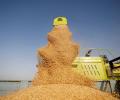
Temperatures in March will be critical to determining the impact of any unusual heatwave conditions on this year's wheat crop in North India. It is that time of the year when the crop enters its vital grain-filling stage, say meteorologists and crop experts. So far, the high day temperatures in the North are not believed to have any significant impact on the final yields since the crop hasn't entered a stage where heat affects yields.
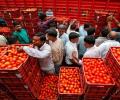
In a first, the Centre will start selling tomatoes at discounted rates in retail markets in the national capital and few other cities from Friday to provide relief to the consumers as the price of the kitchen staple is ruling high at over Rs 200 per kilogram in some parts of the country.
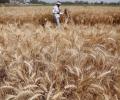
The surge in wheat export from India owing to the Ukraine crisis has once again demonstrated how farmers in states that have flexible marketing frameworks and low taxes benefit more from an emerging situation. The bulk of the wheat exported from India, trade and industry sources say, is being sourced at rates significantly higher than the state-mandated price of Rs 2,015 per quintal in Madhya Pradesh (MP), Uttar Pradesh (UP), and Gujarat - states which have low mandi taxes compared to Punjab and Haryana. This is not only benefiting farmers there but could also lead to significant savings for the states in procurement costs in the months to come.

Ghanwat, also a senior leader of Shetkari Sangathan, said he will mobilise one lakh farmers and bring them to Delhi in the next couple of months demanding farm reforms.

'While every year presents new challenges, it also provides opportunities for better growth and performance.'

With the farmers' protest against the three new laws and in support of legalising the minimum support price (MSP) going strong, state governments have announced a slew of measures in their annual Budgets to placate farmers. The Centre kicked things off in the Union Budget by assuring farmers that the MSP would continue and coming out with a report card to demonstrate its commitment. However, these efforts don't seem to have yielded tangible results. In their respective Budgets, states chose to go a step further by announcing a variety of measures.

The decision, taken by the Cabinet Committee on Economic Affairs headed by Prime Minister Narendra Modi, comes less than a year before next general election.
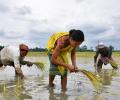
In the coming months, globally as well as in India, rice might remain a hot potato.

India has put curbs on wheat exports through the government route, starting November last year. This comes amid a surge in domestic prices of the cereal. In December, India exported 391 tonnes of wheat to Bangladesh and Bhutan. In November 2022, it had exported 375 tonnes of wheat only to Bhutan.

Ironically, rival Tamil Nadu governments expend the most on social welfare schemes, especially targeting women and youth and children, but that money comes only by selling more liquor. There is always the specious plea, which has been peddled very many times in the past, that without licensed liquor, drinkers would go after hooch and there could be more hooch tragedies and hooch deaths. No one is convinced, but no one can dispute it either, comments N Sathiya Moorthy.

The TDP and JD-U will have a lot to answer inside Parliament, day after day, session after session, notes N Sathiya Moorthy.

The report, which was submitted to the apex court on March 19, 2021, was made public on Monday. The three-member committee had also suggested many changes in the laws, including giving freedom to states to make Minimum Support Price (MSP) system legal.
President Ram Nath Kovind on Monday said the country's farm production and procurement increased during 2020-21 crop year despite the pandemic and agricultural exports reached a record level of Rs 3 lakh crore during the same period. In his address to the joint sitting of both Houses of Parliament at the start of the Budget session, Kovind said the government is focusing on making the country self-sufficient in edible oils besides making special efforts to promote organic farming, natural farming and crop diversification. "My government is working continuously to empower the farmers and the rural economy of the country... I would like to give maximum credit to the small farmers of the country for this consistent success and strengthening of the agriculture sector," he said.

'Due to rural stress, volumes continue to remain an issue for the industry, and we are yet to see any revival in demand.'

District election officer Mahendra Bahadur Singh said Aman Giri won by a margin of 34,298 votes. He received 1,24,810 votes while Tiwari got 90,512 votes.

He expressed hope that the deadlock between the farmers and the Central government will end soon and said he is constantly in touch with the Union Ministers regarding the issue.
India achieved record foodgrains production this year but the withdrawal of three agri-reform laws and spike in cooking oil prices cast a shadow on the country's resilient agriculture sector that is on course for better harvest in 2022 despite pandemic blues. While soaring production of foodgrains that also helped the government provide free additional rations for COVID-hit poor families for many months together came as a relief, the passing year will be remembered for the long drawn farmers' protest at Delhi borders against the three laws and subsequent repeal of the legislations. The Indian agriculture sector, which was among the few segments that remained robust amid the pandemic gales, is expected to register a growth rate of 3.5 per cent in the current financial year ending March 2022.
The area under paddy - the biggest foodgrain during the kharif season - was almost 13 per cent lower in the week ended August 5 as compared to the same period last year despite a slight pick-up in rains in the main growing regions, triggering fears of a 10-12 million-tonne drop in final output. Sources said with the peak sowing season for paddy almost coming to an end in the big-growing states, any uptick in coverage from here onwards may not give the desired yields. With 30 per cent of normal average area in which paddy is grown every year remaining unsown till early August, there is a limited chance of a big uptick in output, trade and market sources said.

Bharatiya Kisan Union leader Rakesh Tikait claimed that the crops are not procured by the government as per the MSP.

A meeting between Mann and several farmer leaders took place at Punjab Bhawan to discuss their demands, including a bonus on wheat and beginning paddy sowing from June 10, the sources said.

Elections are scheduled in five states of Uttar Pradesh, Uttarakhand, Manipur, Goa and Punjab.

State Bank of India's house economists on Monday said the recent farm sector reforms reek of parochial thinking and promote lazy farming as they only cater to cereal-producing states. In the recently concluded monsoon session, the government rushed through three legislation to change the way agricultural produce is marketed, sold and stored by dismantling the decades-old APMC (Agricultural Produce Market Committee) mandis.

The decision to increase the MSPs (Minimum Support Prices) was taken at a meeting of the Cabinet Committee on Economic Affairs (CCEA) chaired by Prime Minister Narendra Modi. MSP is the rate at which the government buys the grain from farmers. Currently, the government fixes MSPs for 23 crops grown in both kharif and rabi seasons. Sowing of rabi (winter) crops begins from October immediately after the harvest of kharif (summer) crops.

The Centre will promote Kisan Drones, chemical-free natural farming, public-private partnerships for the delivery of digital and high-tech services to farmers across the country during the financial year 2022-23, Finance Minister Nirmala Sitharaman said on Tuesday. Presenting the Budget 2022-23 in Parliament, Sitharaman said the inclusive development is one of the four priorities of the government moving forward. As part of the inclusive development, the government will promote the use of 'Kisan Drones' for crop assessment, digitisation of land records and spraying of insecticides. The government will also facilitate a fund with blended capital raised under the co-investment model through Nabard to finance agri start-ups and rural enterprises, she said.

"Mr Modi has utterly failed. It is clear by now that we (NDA) cannot deliver more than this (since 2014)," he said.

Farmer Ishwar Gaykar (36), from Pachghar village in Junnar tehsil of Pune district, had faced a difficult decision of dumping a large quantity of harvested tomatoes in May this year due to low prices.
The government on Monday said there is sufficient wheat stock in the country and that it will take action against hoarders, if needed, to boost domestic supply. The Centre may consider steps like asking for disclosure of wheat stocks by traders and imposing stock limits to augment domestic availability. Addressing the 82nd AGM of Roller Flour Millers Federation of India, food secretary Sudhanshu Pandey said there is no problem of wheat in the country and the Centre has 24 million tonne of wheat in godowns of state-owned FCI. The secretary pointed out that wheat prices have gone up due to "speculative trading".
The fear of price rise gained momentum after reports surfaced that the NAFED procured 50,000 tonnes of onion this season.
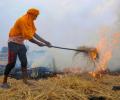
To prevent rise in air pollution levels, oil marketing companies and thermal power units were planning to procure stubble from farmers to make bioethanol and promote the central government's 'Agricultural Mechanization' for crop residue management. But both have seen minimal success.

According to the ministry's statement, Tomar thanked the BKU (Kisan) leaders for coming out in support of the Farm Acts and said these laws have been welcomed in various states across the country.

Data shows that the current system of decentralised marketing and centralised procurement helps Punjab and Haryana farmers the most, while its efficacy in other states has been poor. Experts and farm leaders say success of the laws rests heavily on implementation.

With paddy growers being blamed for causing air pollution, farm experts and farmers' outfits said they are compelled to burn stubble as they do not have any other feasible and cheap option.
India's wheat exports could touch a new record of 10 million tonnes in 2022-23, up from a record seven million tonnes in the current financial year, if global market conditions remain choppy and no curbs are imposed on outbound shipments. That is the bullish estimate by officials from global trading firms and market watchers who say the Russia-Ukraine crisis has not only attracted global buyers to India but also pushed the price of Indian wheat from around $320 per tonne (FOB) to over $360 per tonne in less than 10 days. Food secretary Sudhanshu Pandey told reporters that wheat exports till February-end have already reached 6.6 million tonnes and by the end of March, outbound shipments will reach seven million tonnes.

Prime Minister Narendra Modi on Friday said the government is committed towards procurement of agri crops at minimum support price (MSP) and termed it as an important part of the country's food security. He further said that efforts are being made to improve mandi infrastructure so that MSP buying continues in a scientific way.

Home Minister Rajnath Singh said that the decision could cost the government roughly Rs 15,000 crore.

Robust procurement of paddy and wheat since 2017 and prompt payment to farmers have helped the UP government cultivate a positive and pro-farmer perception, defusing possible farm face-off situations.

The irony of this scheme to benefit farmers is that it could add to the problems for the government because the mechanism to procure and store crops like pulses, coarse cereals and oilseeds barely exists.

The limited availability of flexible (flex)-fuel vehicles in the Indian market and the slow rollout of ethanol-blended petrol by oil-marketing companies (OMCs) remain major obstacles to achieving widespread use of biofuels in the transportation sector in India. Recently, two Union ministers have emphasised India's biofuel potential, arguing that it has the capacity and potential to lead a transition towards widespread biofuel adoption. Road Transport Minister Nitin Gadkari signalled that this transition is well underway and urged car manufacturers to quickly adapt and introduce new biofuel-run vehicles, lest the government resort to taxing diesel vehicles.

Adequate currency in circulation, temporary shortage to be tackled quickly, says FM
